

Suzdal, Northeast Russia, Early 1950s
by Robert Townsend
This article is a working document—background research assembled to keep the fiction honest. It draws on Russian-language sources, Memorial Society databases, German and Italian POW records, and the physical archive of the Vladimir-Suzdal Museum-Reserve. Where a fact matters to the story, I have tried to pin it down. Where the record is silent, I have said so.(Claude used (AI) for research.)
I. THE PLACE: SUZDAL AND ITS GEOGRAPHY

Suzdal sits in the Vladimir Oblast of northeast Russia, roughly 26 kilometres north of Vladimir city, along the Kamenka River, a tributary of the Nerl. [1] The Kamenka is not navigable upstream beyond the town; it has always been a dead end in the physical sense, which may explain why Suzdal never industrialised and why, in 1953, it looked much as it did in 1853. The Soviet planners left it alone. The golden-ring tourist bureaucracy had not yet arrived. What you had was a small medieval town—population under ten thousand—dominated by church domes, monastery walls, and the memory of things that had happened inside them.
The region around Suzdal is some of the richest black-earth agricultural land in central Russia, laid down by the Klyazma River system and extending along the right bank of the Nerl. [2] The left bank, by contrast, carries poor and thin soils studded with pre-historic grave markers—hunters and gatherers who left behind bones, axes, and fragments. Slavic settlers moved into these forests in the ninth century, probably driven north and east out of the great river corridors of the steppe by nomadic pressure. The land they found was forested, cold, and defensible.
Ancient Vladimir occupied a plateau riven with deep ravines on the left bank of the Klyazma, fifty metres above the river, well-defended and well-connected to Eastern Europe via the Volga. [3] Even into the twelfth century the city gates opening onto the Klyazma were called the Volga Gates—not the Klyazma Gates—because that is where the money came from. Coinage from Samarkand, Bukhara, and Germany has been found in sarcophaguses across the region, testament to how far the trade routes reached.
By 1953, the Kamenka was still the axis of the town’s daily life. On the east bank: the kremlin, the bishop’s palace, the market. On the west bank, across the wooden bridges: Illian Meadow and the open farmland. To the north of the town centre, on high ground above the river: the Spaso-Evfimiev Monastery, its red-brick walls and twelve towers visible from anywhere on the plain. That monastery is where this story lives.
II. THE MONASTERY: SEVEN CENTURIES OF CONFINEMENT
The Spaso-Evfimiev Monastery—Спасо-Евфимиев монастырь—was founded in 1352 by Prince Boris Konstantinovich of Suzdal-Nizhny Novgorod, as a fortified monastery dedicated to the Saviour, positioned on the high left bank of the Kamenka to serve as the town’s northern fortress. [4] The original wooden buildings burned in the Polish-Lithuanian invasions of the early seventeenth century. The brick walls and towers that replaced them—twelve towers in all, constructed between 1670 and 1680—are what you see today. The walls stretch 1,200 metres. The corner and gate towers are massive; the river-side walls are lower, because the cliffs do that work for them.
The monastery’s transformation into a place of confinement began officially in 1766, when Catherine the Great ordered it converted into a prison for “madmen and disturbers of the peace”—the phrase covering, as it always has in Russia, a considerable range of people the state found inconvenient. [5] Heretics, sectarians, political opponents, and simply those who had annoyed someone important all passed through. The Decembrist Fyodor Shakhovsky died here in 1829. The leader of the Pryguns sect, Maxim Rudometkin, who declared himself the embodiment of the Holy Spirit in 1857, spent his last years here writing fourteen books of prophecy. The prison operated until 1905.
The Soviet era reopened the monastery’s penal function without delay. By 1923 it had become a politizolyator—a political isolator—for opponents of the new regime. [6] In this capacity it held, among others, the economist Nikolai Kondratiev (originator of the “Kondratiev wave” theory of economic cycles) and Leonid Yurovksy, architect of the 1922 currency reform. Both were eventually shot. The Suzdal isolator had its own abbreviation: SLON, the same acronym as the notorious Solovetsky Islands camp—both derived from the Russian for “Special Purpose Camp.”
In 1939 the political isolator was closed. The building briefly served a tractor school. [7] In 1940 the monastery received its first international prisoners: interned soldiers of the Czech Legion of the Polish Army, led by Ludvik Svoboda, taken prisoner during the Soviet invasion of eastern Poland in September 1939. They were released in July 1941 to fight Germany after the Nazi invasion of the USSR, and were re-armed to form what became the Czechoslovak Army Corps on the Eastern Front.
In December 1941, as the Wehrmacht stood before Moscow, the monastery became an NKVD filtration camp for Soviet soldiers who had been captured or surrounded by the Germans and had escaped or been released. [8] These men—8,232 of them in total—were processed here: interrogated, assessed, classified. Those found innocent of collaboration were returned to service. Those found wanting were sent to penalty battalions to “wash away the shame with blood,” as the official phrase had it. The architecture of suspicion was already embedded in the walls before the Germans arrived.
III. CAMP 160: THE GERMAN AND AXIS OFFICERS, 1943-1946
On 1 January 1943—even before the final surrender at Stalingrad on 2 February—the Spaso-Evfimiev Monastery was redesignated as NKVD Camp No. 160, for the reception of captured Axis officers. [9] After the encirclement was complete, the question of where to put 91,000 prisoners became urgent. The overwhelming majority went to labour camps across the Soviet interior, where most would die. Camp 160 was reserved specifically for officers—and for the most prominent among them.
In early March 1943 the residents of Suzdal saw the first columns arrive. The prisoners had been transported by train to Vladimir—some 40 kilometres to the south—and from there marched on foot to the monastery. [10] Many had fought in the south, in the ferocious warmth of the Caucasus and the Volga steppe. They had no winter coats appropriate for a Russian March. The temperature on the open road to Suzdal was minus twenty or lower. The townspeople who came out to watch expected, according to later testimony, to see the ferocious invaders of Soviet propaganda—square-jawed, helmeted, contemptuous. They saw instead exhausted, ragged, frostbitten men, some of them barely able to walk.
What happened next is documented in the memoir of an Italian second lieutenant, Ugo Spacamonte, who returned to Suzdal in 1993, fifty years after his imprisonment there. He wrote: [11] “I would like to thank all those women who, when we were on the marches ‘davai-davai’, gave us a piece of bread at risk to themselves.” The guards drove sympathisers away from the columns and forbade the passing of food. Not all guards enforced this equally.
Andrei Babakov, the researcher at the Vladimir-Suzdal Museum-Reserve who has spent decades with these materials, confirms that local contact occurred despite prohibition. [12] Women—and it is nearly always women in such accounts—passed bread through fences, across roads, through gaps in supervision. The German prisoners were also, in the early months, terrified of being taken to bathe: they refused, believing the bathhouse was a gas chamber. It took considerable effort by the NKVD interpreters to persuade them otherwise.
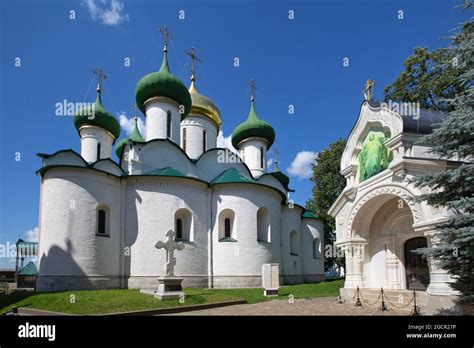
The physical arrangement inside the monastery was hierarchical. German officers occupied the Spaso-Preobrazhensky Cathedral—the main church, with its frescoed vaults and the tomb of Prince Pozharsky. [13] Italian officers were housed in the Bratsky Korpus, the fraternal quarters building. Ordinary soldiers were in wooden barracks erected along the inside of the monastery walls. Officers of the Soviet Army and NKVD personnel who spoke German, Italian, Romanian, Hungarian, or Spanish were assigned to the camp as guards and interpreters.
The nationalities held at Camp 160 reflect the multi-national character of Hitler’s eastern coalition: Germans, Austrians, Italians, Romanians, Hungarians, and a small number of Spaniards—soldiers of the “Blue Division” (División Azul), which had fought in the Novgorod and Leningrad sectors. [14] In total, 5,381 individuals passed through Camp 160 between March 1943 and its closure on 3 July 1946. The camp operated for three years and four months.
Conditions before May 1943 were lethal by starvation and disease. Food consisted almost exclusively of sour cabbage soup or nettle soup, without protein, and a ration of black bread described by survivors as issued “almost every day.” [15] Typhus moved through the barracks. Of the more than 7,000 Italian officers taken prisoner in the Soviet campaign—not all at Suzdal—fewer than 650 ever returned to Italy. Of those captured in the first year of the war, only four survived to repatriation. After May 1943, Soviet government concern about international opinion and better camp administration sharply improved the food supply and reduced the death rate.
The ration schedule, as specified by NKVD circular, provided: 400 grams of bread per day (raised to 600-700 grams after 1943), 100 grams of fish, 100 grams of grain, 500 grams of vegetables and potatoes, 20 grams of sugar, 30 grams of salt, plus small quantities of flour, tea, vegetable oil, vinegar, and pepper. [16] Generals and severely malnourished soldiers received larger portions. Prisoners who performed rated labour received monetary allowances: 7 roubles per month for private soldiers and junior NCOs, 10 for officers, 15 for colonels, 30 for generals. Those who exceeded production norms could receive up to 100 roubles. Officers and generals were forbidden, as a specific indignity, from having orderlies.
IV. PAULUS, THE GENERALS, AND THE POLITICAL DIMENSION
The most famous prisoner at Suzdal was Generalfeldmarschall Friedrich Paulus, commander of the German Sixth Army—the first German field marshal ever to surrender to an enemy. His route to Suzdal was indirect. [17] After his capture at Stalingrad on 31 January 1943, Paulus was initially delivered to NKVD camp No. 27 in Krasnogorsk, near Moscow, in February and April 1943. He then spent time at the Spaso-Evfimiev Monastery in Suzdal before being moved again. The NKVD had concerns, apparently serious, that the Germans might attempt a parachute or commando operation to liberate him—which says something about both the political value of the man and the paranoia of the times.
When the National Committee for a Free Germany was formed at Krasnogorsk in mid-1943, Paulus—already at Suzdal with his generals—immediately denounced the collaborating officers as traitors and declared he could no longer consider them comrades. [18] He held this position until August 1944, when military collapse on all fronts convinced him to sign an appeal to German soldiers and officers to lay down their arms. He remained in Soviet custody until 1953—the year of this novel—when he was finally repatriated to East Germany, not West Germany, which tells you something about how the Soviets saw him by the end.
Other notable Stalingrad generals at Suzdal and the related camp system included Generals Schmidt, Pfeiffer, Korffes, and Colonel Adam (Paulus’s aide-de-camp). [19] General Walter von Seydlitz-Kurzbach, who led the National Committee faction and was the most active collaborator, was kept in Russia after the war on a Moscow-area dacha, consulting on the Soviet film about Stalingrad and writing his memoirs. He was then arrested in 1950, sentenced to 25 years, kept in solitary, and released only in 1955 after Adenauer’s visit to Moscow. His life is a study in the costs of usefulness.
Alexander Blank, a young NKVD interpreter at Camp 160 in 1943, kept notes of his daily observations. [20] Blank later became a historian of the Third Reich and Soviet-German relations; his published work includes “Kommunisty v nemetskom plenu” (Communists in German Captivity, 1974). The notes he kept at Suzdal—released forty years after the events—are the most direct inside account of the camp’s daily workings from the Soviet side, and are described by researchers as “pure gold” for reconstructing the atmosphere. They are in Russian and have not, to my knowledge, been translated into English.
V. THE TOWN AND THE CAMP: WHAT THE CITIZENS SAW
Suzdal in 1943 was a town of under ten thousand people, many of whose men were at the front. [21] The women, children, and old men who remained were operating under wartime rationing, wartime ideology, and wartime grief. The propaganda they had absorbed told them the Germans were subhuman monsters. The figures who marched through their streets in March 1943 were demonstrably human—starving, frightened, some of them dying on their feet.
This cognitive dissonance is the engine of my novel’s opening. The town could not look away from the camp, and the camp could not fully seal itself from the town. The monastery walls are high, but the town is small, the population is rooted, and everyone knows someone who works there—as a cook, a laundry woman, an electrician, a telephone operator. The NKVD personnel who guarded the camp lived in the town. Their children went to the same school as every other child in Suzdal.
Contact between prisoners and townspeople was officially prohibited but demonstrably occurred. [22] The bread-passing episodes documented in Italian memoirs are the most vivid examples, but there were others. Some of the Italian prisoners, speaking to researchers decades later, described moments of wordless human exchange—a nod through a fence, a gesture, a look—that they carried for the rest of their lives. The Russian women who gave them bread were taking a real risk: in 1943, fraternising with enemy prisoners was a criminal act.
The camp also generated economic activity that drew the town in. Guards needed housing, food, services. The camp administration needed local suppliers, local labour for ancillary work. [23] An NKVD officer stationed at Camp 160 would have been a figure of real consequence in a town that size—access to resources, to information, to the machinery of the state. His children would have occupied a specific and uncomfortable social position: privileged but tainted, the children of the men who ran the place nobody spoke about openly.
VI. 1953: THE YEAR THE NOVEL IS SET
The camp itself closed on 3 July 1946. The monastery was converted into a juvenile detention colony for boys, which it remained until 1967, when it was finally transferred to museum use. [24] So in 1953, the setting of this novel, the monastery no longer holds German officers. It holds Soviet boys—delinquents, orphans of the war, children of the Gulag. The stone buildings and frescoed cathedral that housed Paulus’s generals now house damaged Russian children. The NKVD guards have become juvenile colony wardens. The physical space is the same; the social meaning has shifted.
But the memory of the camp is very much alive in 1953 Suzdal. It has been only seven years. [25] The women who passed bread through the fences in 1943 are still there, in their thirties and forties. The NKVD men who ran the camp are still in the town—some promoted, some transferred, some still in the same positions now applied to juvenile justice. The physical infrastructure of the camp years—the barracks, the wire, the guard posts—has not all been dismantled. What you have in 1953 Suzdal is a palimpsest: each layer of the monastery’s history visible beneath the next, if you know how to look.
The political atmosphere of 1953 is itself extraordinary. Stalin dies on 5 March 1953. [26] Beria announces an amnesty—but it covers non-political prisoners and those with sentences under five years, which means it largely empties the regular criminal camps while leaving the political prisoners untouched. Within months, Beria himself is arrested—26 June 1953—charged with treason and espionage, and shot in December. The NKVD, renamed the MGB and then the MVD, is reorganizing under Kruglov. For anyone whose career and identity were tied to the NKVD, the spring and summer of 1953 is a period of acute institutional vertigo.
An NKVD officer’s son in Suzdal in that spring is living through a moment when his father’s world—the world that gave the family its social position, its rations, its apartment, its authority—is cracking. The Suzdal of 1953 is the Suzdal of recovered memory: the war is close enough to taste, the camp is recent enough to haunt, and the political ground is shifting under everyone’s feet. That is the atmosphere I am trying to capture.
VII. THE EARLIER PRISONERS: THE POLITICAL ISOLATOR, 1923-1939
Before the German officers and before the Soviet filtration camp, the Spaso-Evfimiev Monastery held a different class of prisoner: Soviet intellectuals and political opponents. [27] The Suzdal politizolyator operated from 1923 to 1939, under the acronym SLON—the same abbreviation as the Solovetsky Special Purpose Camps, though a coincidence rather than an administrative connection. Among those confined here were:
Nikolai Kondratiev (1892-1938), the economist who formulated the theory of long economic cycles now known as “Kondratiev waves.” He was first arrested in 1930, confined at Suzdal, then re-arrested in 1937, convicted of leading a “Peasants’ Labour Party,” and shot on 17 September 1938. Rehabilitated in 1987.
Leonid Yurovksy (1884-1938), architect of the Soviet currency reform of 1922 that stabilized the rouble through the introduction of the gold-backed chervonets. He was arrested, confined at Suzdal, tried for counterrevolutionary activity, and shot on 17 September 1938—the same day as Kondratiev. The men who had built Soviet financial policy were executed on the same afternoon.
Alexander Slepkov (1899-1937), Soviet journalist and historian, a protégé of Bukharin, was sentenced to three years in the political isolator at Suzdal in 1933 for his opposition to forced collectivisation. [28] He was re-arrested in 1937, accused of organising a terrorist group, and shot on 26 May 1937. A fellow prisoner at Suzdal in 1933 described him in a memoir smuggled to Paris and published in 1970: “Of the educated youth in the first years of Soviet power, Aleksandr Slepkov was the most outstanding. He had a warm heart and lucid mind.”
The political isolator period matters to the novel because it establishes the monastery as a place with layered institutional memory. By 1953, the building has held tsarist sectarians, Soviet economists, Czech legionaries, German generals, and Russian delinquents—each layer invisible to the next, but present in the stones. [29] An NKVD family resident in Suzdal through these years would have witnessed, or been adjacent to, several of these phases. The father in my novel is not a simple villain; he is a man formed by institutions that themselves changed character multiple times within a single career.
VIII. THE DATABASES: WHAT MEMSEARCH AND MEMORIAL HOLD
The Memorial Society—Международное общество “Мемориал”—was founded in the late Soviet period to document the victims of political repression. Before its forced liquidation by the Russian state in December 2021, it had assembled the most comprehensive archive of Gulag and repression materials in existence. [30] Its databases survive and remain accessible, maintained from outside Russia by partner organisations including the Czech organisation Gulag.cz.
The umbrella search system at memsearch.org—”Memory of Repression”—aggregates data from Memorial’s multiple databases and from partner institutions across the former Soviet space. [31] For research on Suzdal specifically, the most relevant Memorial databases are:
base.memo.ru — The main victims database, over 3 million records. Search “Суздаль” as place of imprisonment to locate individuals held at the political isolator. Results include name, year of birth, charge, sentence, and fate where known.
memoirs.memo.ru — Annotated and scanned inmate memoirs from the Memorial archive. The catalogue contains 3,846 memoir authors, 7,292 bibliographic records, and 1,689 digitised texts. Search terms: “Суздаль,” “политизолятор,” “лагерь 160.”
museum.memo.ru — The Memorial Museum collection: drawings, paintings, handicrafts, and objects created by Gulag prisoners. The 1998 catalogue “Tvorchestvo i byt GULAGa” covers this material with emphasis on daily life and prisoner artwork.
nkvd.memo.ru — Personnel database of NKVD workers. Useful for understanding the career structure and typical biography of someone in the position of camp commandant or guard officer at a facility like Camp 160.
For the POW camp specifically—Camp 160—the relevant archival trail runs through GUPVI (Главное управление по делам военнопленных и интернированных), the Main Administration for Prisoner of War and Internee Affairs, which was a separate bureaucratic structure within the NKVD/MVD from the regular Gulag (GUPVI handled foreign POWs; GULAG handled Soviet prisoners). [32] GUPVI records are held in GARF (Государственный архив Российской Федерации), Fond 9526. The Vladimir Oblast State Archive (GAVO), at ul. Baturina 8, Vladimir, holds local administrative records for the region.
The Vladimir-Suzdal Museum-Reserve itself—with its permanent exhibition “Suzdal Prison: A Chronicle of Two Centuries of History”—is the single most accessible starting point for physical documentation. [33] The museum holds photographs of the German POW period, objects left by prisoners, and the research notes of Andrei Babakov, whose published and unpublished work on Camp 160 is the most detailed treatment of the subject in Russian. The museum is located within the monastery complex itself, at ul. Kremlyovskaya 8, Suzdal.
IX. THE LITERARY THREAD: TONINO GUERRA AND ANDREI TARKOVSKY
One of the prisoners held at Camp 160 was Antonio “Tonino” Guerra (1920-2012), an Italian poet, writer, and screenwriter who would go on to become one of the most significant figures in European cinema—collaborating with Michelangelo Antonioni, Federico Fellini, Theo Angelopoulos, and Andrei Tarkovsky. [34] Guerra was arrested in August 1944 at the age of 22, a schoolteacher from Santarcangelo di Romagna found with partisan leaflets in his pockets, and interned in a German camp. He began writing poetry in his native Romagnol dialect to entertain his fellow prisoners—a practice that launched his literary career.
The connection between Guerra and Tarkovsky runs through Suzdal in a way that is almost too good for a novelist to believe. Tarkovsky, born in 1932 in the village of Zavrazhye, grew up largely in the Vladimir Oblast region—the same landscape as Suzdal, the same gold-domed churches, the same flooded meadows and birch forests that appear obsessively in his films. [35] When Guerra later collaborated with Tarkovsky on “Nostalghia” (1983) and the documentary “Voyage in Time,” their shared sensibility—an Italian poet imprisoned in the Soviet world, a Russian filmmaker exiled from it—generated a creative conversation rooted in exactly this geographical and historical terrain.
The Spaso-Evfimiev Monastery now holds a permanent exhibition entitled “Intertwined Fates,” which documents the imprisonment of Italian POWs at the monastery and traces the artistic legacies of Guerra and Tarkovsky. [36] This exhibition is housed in the Monks’ Quarters building—the same building that served as the Italian officers’ barracks during the war. The physical space has been restored to cultural use; the institutional memory persists in the walls.
X. THE NKVD FAMILY: SOCIAL POSITION AND DAILY LIFE
The central fact about an NKVD officer’s family in a small town like 1950s Suzdal is that they were visible. There was nowhere to disappear. [37] The NKVD officer had access to resources unavailable to ordinary citizens—better rations, better housing, perhaps a car or at least a telephone—but he also carried, in a town that small, the social weight of what his institution had done. In Suzdal this was not abstract: the political isolator of the 1930s had taken local residents. Everyone knew someone who had been sent away from here, or processed through here, or not come back.
The position of the officer’s children was particularly exposed. They attended the same schools as everyone else. They played in the same streets. They knew, and were known by, children whose fathers had been taken away by people like their father. [38] The social psychology of this—the mixture of privilege, shame, complicity, and pride—is one of the novel’s central preoccupations. Danton Larionov is not simply the bully of his father’s power. He is also a fourteen-year-old who has grown up in the echo chamber of an institution that defines violence as justice and calls it order.
By 1953 the camp had been closed for seven years, but the personnel largely remained. [39] Some had been transferred to the juvenile colony that replaced it; some had moved into other MVD functions in the region; some had simply stayed, as people do in small towns, living out their careers and their marriages and their memories in the same streets. The father in this novel is a man of the institution: he has no other identity. When the institution begins to crack—as it does in the spring of 1953, with Stalin’s death and Beria’s fall—the father’s world does too.
XI. SOURCES AND RESEARCH NOTES
The following notes indicate the primary sources behind each section’s major claims. Russian-language sources are cited in transliteration where a published English translation does not exist. I am working from originals in those cases.
1. Wikipedia, “Suzdal,” citing the 2021 Census (population 9,286) and geographic data. The Kamenka as tributary of the Nerl, and the Nerl as tributary of the Oka-Volga system, is standard Russian geographic reference.
2. Robert Townsend, “The Executioner’s Son,” liarspath.com, 20 November 2013, citing Russian-language monographs on the Vladimir-Suzdal region (translations now removed from the site; originals in author’s possession).
3. Ibid. The Volga Gates reference is from the Old Russian chronicles; the archeological coinage finds are reported in regional excavation reports held by the Vladimir-Suzdal Museum-Reserve.
4. Wikipedia, “Monastery of Saint Euthymius”; “Spaso-Evfimiev monastyr v Suzdale,” culture.ru. The founding date of 1352 and the role of Prince Boris Konstantinovich are standard in all sources.
5. Wikipedia, “Monastery of Saint Euthymius”; Yaplusoni.ru, “Spaso-Evfimiev monastyr, Suzdal: tyurma i plennye.” Catherine the Great’s 1766 decree is cited in all major sources on the monastery.
6. Dergachev-va.livejournal.com, “Suzdalskaya monastyrskaya tyurma. Sovetskoe zazerkale.” The SLON acronym and the political isolator period 1923-1939 are documented in Russian Wikipedia (ru.wikipedia.org, “Spaso-Evfimiev monastyr”) and the Museum-Reserve exhibition.
7. A-malyavin.livejournal.com, “Spaso-Evfimiev monastyr, Suzdal, chast 1.” The tractor school period (1939) and the Czech legionaries (1940) are confirmed in ru.wikipedia.org, “Spaso-Evfimiev monastyr.”
8. Ru.wikipedia.org, “Spaso-Evfimiev monastyr”: “V 1941 godu… byl organizovan proverochno-filtratsionny lager, v kotorom soldaty i ofitsery RKKA prokhodili proverku posle prebyvaniya v plenu… Cherez nego proshli 8232 cheloveka.”
9. Ru.wikipedia.org, “Spaso-Evfimiev monastyr”: “1 yanvarya 1943 goda monastyr stal lageryem voyennoplennykh.” Wikipedia (en), “Monastery of Saint Euthymius.”
10. RIA Novosti, Marina Lukovtseva, “Lager v suzdalskom monastyre: kak v SSSR soderzhali voyennoplennykh,” 9 May 2018. Quoting researcher Andrei Babakov of the Vladimir-Suzdal Museum-Reserve on the march from Vladimir.
11. Ibid. The memoir of Ugo Spacamonte (rendered in some sources as “Hugo Sakamoto”—a transliteration error) is quoted by Babakov in the RIA Novosti article. Spacamonte visited Suzdal in 1993.
12. Ibid. Babakov’s account of the bathhouse episode and the women passing bread is based on archival materials held by the Vladimir-Suzdal Museum-Reserve.
13. Yaplusoni.ru, “Spaso-Evfimiev monastyr, Suzdal: tyurma i plennye”; RIA Novosti 2018. The use of the Spaso-Preobrazhensky Cathedral for German officers is confirmed in multiple Russian sources.
14. RIA Novosti 2018, citing Babakov. The presence of the Blue Division soldiers (Spanish volunteers) is confirmed in Wikipedia, “Italian prisoners of war in the Soviet Union.” Total of 5,381 prisoners: RIA Novosti 2018.
15. Rttl.me, “When absolute beauty turned into absolute horror” (Russia Through the Lens), 2019, on Camp 160 and Italian officer mortality. The nettle soup diet is confirmed in Italian POW memoirs cited in Wikipedia, “Italian prisoners of war in the Soviet Union.”
16. Rossiyskaya Gazeta, “Nemetskie voyennoplennye posle voiny poluchali v SSSR zarplatu,” 28 June 2012. The ration schedule and payment scale are from NKVD circular of 25 August 1942 as reported in this source.
17. Wikipedia (en), “NKVD special camp No. 48”: Paulus at Krasnogorsk February-April 1943, then Suzdal. The paratrooper-rescue fear is mentioned in the Asia Pacific Research Centre summary, apircenter.org.
18. Rossiyskaya Gazeta, “Nemetskie komandiry v sovetskom plenu,” 17 July 2014: Paulus’s denunciation of collaborating generals and his eventual change of position in August 1944.
19. Ibid. Seydlitz-Kurzbach’s postwar career in Soviet custody is detailed in the same Rossiyskaya Gazeta article. His 1950 arrest and 1955 release follow from Adenauer’s September 1955 Moscow visit, which secured the release of the last German POWs.
20. Military-stuff.org, “Suzdal Camp 160: The Fate of the German Officers Captured at Stalingrad,” 27 November 2021, citing Blank’s notes published approximately 1983. Alexander Blank’s major published work: “Kommunisty v nemetskom plenu” (Moscow, 1974).
21. Suzdal’s wartime population is not precisely documented in available sources, but the town had approximately 10,000 residents in the 1939 census; wartime male absence was typical for the region.
22. RIA Novosti 2018; Spacamonte memoir as cited by Babakov; Wikipedia, “Italian prisoners of war in the Soviet Union,” citing Vio (2004) on civilian compassion.
23. The economic integration of camp personnel with small towns is documented generally in Gulag scholarship; for Camp 160 specifically, the NKVD requirement for language-competent Soviet officers (RIA Novosti 2018) implies a specialist cadre housed in the town.
24. Wikipedia, “Monastery of Saint Euthymius”: “From 1946 up to 1967 the monastery was turned into youth detention center for boys.” Confirmed in all major Russian sources.
25. The seven-year gap is my own inference from the closure date (3 July 1946) and the novel’s setting (spring 1953). The persistence of camp personnel in small Soviet towns is documented in Tyler C. Kirk, “After the Gulag: A History of Memory in Russia’s Far North” (Indiana University Press, 2023).
26. Stalin’s death: 5 March 1953. The Beria amnesty: 27 March 1953. Beria’s arrest: 26 June 1953. His execution: 23 December 1953. All standard historical record. NKVD/MVD reorganisation: Kruglov as MVD chief from March 1953.
27. Dergachev-va.livejournal.com; ru.wikipedia.org, “Spaso-Evfimiev monastyr.” The politizolyator period 1923-1939 and its inmates are documented in both.
28. Wikipedia (en), “Alexander Slepkov.” The 1970 Paris memoir is identified in that article as the source for the Suzdal cell description. Slepkov’s sentence and execution dates are from Wikipedia.
29. The layered institutional history of the monastery is reconstructed from the sources in footnotes 4-8 above, combined with the Vladimir-Suzdal Museum-Reserve exhibition “Suzdalskaya tyurma: letopis dvukhvekovoy istorii.”
30. The Memorial Society’s liquidation by Russian courts: the Supreme Court order came 28 December 2021. Memorial International was dissolved; Memorial Human Rights Centre followed. The databases continue to operate from outside Russia.
31. Gulag.cz, “Memsearch.org: A new search engine about Soviet repressions.” The Memsearch system and its component databases are described at memsearch.org/en/sources.
32. GUPVI (Fond 9526, GARF) and GULAG (Fond 9414, GARF) are distinct archival collections. The GUPVI/GULAG distinction is standard in Gulag scholarship; see Anne Applebaum, “Gulag: A History” (Doubleday, 2003).
33. The exhibition “Suzdalskaya tyurma. Letopis dvukhvekovoy istorii” is at the Spaso-Evfimiev Monastery complex, ul. Kremlyovskaya 8, Suzdal. Andrei Babakov’s role is confirmed in RIA Novosti 2018.
34. Wikipedia (en), “Tonino Guerra”; Metrograph, “Tonino Guerra: A Poet’s Cinema”; BFI Sight & Sound obituary, 2012. Guerra’s wartime imprisonment was in Germany, not the Soviet Union—a clarification worth noting.
35. Tarkovsky’s childhood geography (Zavrazhye, now Kostroma Oblast, on the Volga) and his lifelong visual engagement with the Vladimir-Suzdal landscape is documented in his diary “Martyrolog” (1989) and in Andrei Tarkovsky, “Sculpting in Time” (1987).
36. Rusmania.com, “Spaso-Yevfimiev Monastery.” The “Intertwined Fates” exhibition and its location in the Monks’ Quarters building are confirmed in this source.
37. The social position of security personnel in small Soviet towns is addressed in numerous memoirs; for the Suzdal context specifically, the camp’s scale (5,381 prisoners over three years, plus guard staff) in a town of under 10,000 would have made NKVD personnel highly visible.
38. The social psychology of NKVD families is addressed in Orlando Figes, “The Whisperers: Private Life in Stalin’s Russia” (Metropolitan Books, 2007), which includes testimony from children of security personnel.
39. The conversion of Camp 160 to a juvenile colony (1946) and the likely persistence of some personnel is inferred from standard Soviet administrative practice; direct documentation for Suzdal specifically would require access to GAVO (Vladimir Oblast State Archive).
* * *
This document will be updated as research continues. Corrections and additional sources are welcome. The novel itself is the destination; this article is the map I am drawing to get there.
Robert Townsend
liarspath.com