

Liars & Storytellers (3) (Background)

“Life’s becoming better, sweeter,” the poster announces. Deception begins with truth, however thin, The Great Famine, 1931-32, witnessed 6-8 million Soviet deaths by starvation. Indeed, in 1934, when this poster appeared, life had gotten better. The dead were dead; the living were not dead.
Winter nights in the 50s were bitterly cold, the snow deep and crusted so one could walk over its surface as if it were of concrete. The V-blade town grader plowed the road, tossing up snow banks that touched the power lines. On a moonless night, the passing car was a moving glow within the foreboding spruce forest, like an opening scene from The Twilight Zone, while on moonlit nights they passed without sound or warning.
The Weinbergs arrived from the north, the Seetans from the south. The dog shot out through his canvas door in the barn wall, his barking enough to raise the dead. ‘Shut the god-damned hell up, before I kick your ass into next week!” the man’s voice echoed off the distant tree line. A high-pitched woman’s voice censured the still night, “Johnny, do you have to swear so god-damned much!?”
The elders sat around the porch table, dealing the Pinochle double-deck, while before them stood whiskey and sours in mismatched jelly glasses, the ice broken from icicles on the porch eaves. We, the children, were eight. The four pre-war siblings appeared in the door frame to the porch to greet the guests as politeness required before disappearing to read books. We, born post-war, were sent away to listen to the radio but slipped back to join the dog under the table and listen to the stories.
Big-hearted and big-mouthed Slavs visiting our isolated 1950s Wisconsin farmhouse taught storytelling and deception. They told big stories about a neighbor’s new Cadillac and Depression-era poverty while bemoaning ungrateful children. Now and then they hinted at that which they escaped––starvation, massacre, war, genocide––fairy tales impressed upon a child’s mind by a momentary silence, a shake of the head, a wife’s anxious glance. Both the veteran and immigrant lacked words to encompass and articulate unspeakable horror.
The Seagrams Seven bottle emptied, and the volume rose. Pinochle cards hit the table like artillery shells while heavy boots stomped the floor to emphasize political truth. “Mark my words, Archie, when Tito goes, you Serbs and Croats will be at one another’s throats…!” Now and then, a massive shoe stamped a paw or hand, bawling beneath the table, interrupting the brawling above. The big people would run the children and dogs off only to have us (sly little Indians) creep back under. We learned certain working truths.
My father lied.
Once, an older sister, an articulate and fearless college sophomore, looked directly into his eyes to ask, “Do you know when you’re lying?” Family lore has it that my great-grandmother was a Seminole Indian, a history that played significantly in my family story. My mother, when father’s lies were particularly egregious, would spit out the epithet ‘you lying Indian.’ (When I met my Florida/Georgia kinfolk, I found this Indian heritage asserted among the men, denied among the women.) Casual lying seemed to suit my father, but I early found that the pain lying caused was so scorchingly painful that I would go for long periods without speaking for the hurt the misspoken word visited upon the trusting. I learned to speak little, and speak carefully, but it took a decade before I figured out how to signal ‘story’ from ‘truth’ to my listener.
Working truths evolved.
My father was a liar. We know, however, that he had been orphaned thrice by his eleventh year, and ran away from a brutal household in his 14th (or 15th year. A water-stained US Army Form DD 214 documented his combat decorations and war heroism, the regimental first sergeant, his unit in near constant combat from Guadalcanal through Okinawa. They were poised to invade Kyushu when atomic bombs on Hiroshima and Nagasaki precluded the invasion and his likely death. In the end, my father became a respected community leader and politician, but remained a liar. Folks adjusted.
My mother was the storyteller. Lasting the duration of a Pall Mall cigarette, stories were meant to teach while entertaining, thus to hold a child’s attention. “Uncle Josip fell from the catwalk into the vat of molten steel.’ She sipped her coffee. “They sure as shit didn’t bury the vat of slag!” She glanced through the porch window at the morning storm. We visualized his body turn to smoke, his toupee floating atop the fiery metal. She exhaled smoke and stubbed out her cigarette. “He was a Pyanitsa.” Ah, the lesson was ‘don’t go to work drunk (I think)’. “Now, go out and feed the cows.”
In 1965, great adventures beckoned. I left to attend the University of Wisconsin and seek glory as a football walk-on. A world confined to Lincoln County, Wisconsin, expanded 200 miles south to metropolitan Madison, Wisconsin. The complications were immediate. Football demanded but two hours a day over eight weeks. One was expected to study! Go figure. I chose the Russian language for a semester or two to discover perhaps what facts were hidden within those freighted Slavic pauses around the kitchen table.
The University was as if I were slipping into the St. Lawrence River one-quarter mile upstream from Niagara Falls. The waters appeared still; in the distance, a hint of thunder. In Madison, Wisconsin, this callow farm boy encountered human beings exotic beyond his wildest imagining––New Yorkers. Loud, articulate, argumentative, firm in their various opinions, a Phyllis Diller joke comes to mind. “If three New Yorkers enter a taxi without arguing, a bank has been robbed.”
An Ivy League Jewish quota sent the brilliant children of Holocaust survivors into my insular world. They too remembered loud-mouthed uncles who paused, the anxious aunt lifting a hand, a hint at memories too unbearable to speak. My roommate was Michael; think Garrison Keillor assigned to room with Jon Stewart. I dated Julia; think Tom Hanks taking Barbara Streisand to the Kollege Klub for a 25₵ beer.
Books replaced football. I read Malraux’s Man’s Fate but also Robert Conquest’s Harvest of Shame, Pasternak’s Doctor Zhivago, and everything Dostoevsky wrote. I memorized the poetry of Blok, Akhmatova, and Pasternak. The diminutive Professor Victor Terras brought Fyodor Dostoevsky to life into a cold Van Hise classroom. Professor Petrovich’s bald head and caterpillar mustache, just visible over the lectern, lectured on intra-war European history, the approaching WWII storm, a vision that brought to this farm boy’s mind a hot sunny afternoon with dark tornado clouds spilling over moraine hills. Not all professors were brilliant. Two self-satisfied mediocrities team-taught Sociology 101 while spouting bromides (You young women; if you know you’re going to be raped, maybe you should just lie back and enjoy it.) confirming, if nothing else, undeserved idiots occupied positions of respect, like corrupt Catholic priests in my grandmother’s Austro-Hungarian Empire. The war in Vietnam agitated the campuses. Student draft riots rolled up and down Madison’s State Street, and tear gas drifted through my room as I studied the Russian language. Certitudes became as insubstantial as cigarette smoke rising into the buttresses arching over the Student Union Rathskeller’s wooden tables.
A worldview evolved. It had to. The Vietnam War called young men to choose. The truth was mutable and contingent, perhaps, but working truths existed. Socialists, be they National or International, Fascist or Communist, committed genocide. My father and his generation fought the Fascists into submission. In 1969, Communists held power over great swaths of the earth. When Communists came to power, genocide ensued. It was as if one plus one equals two.[2]
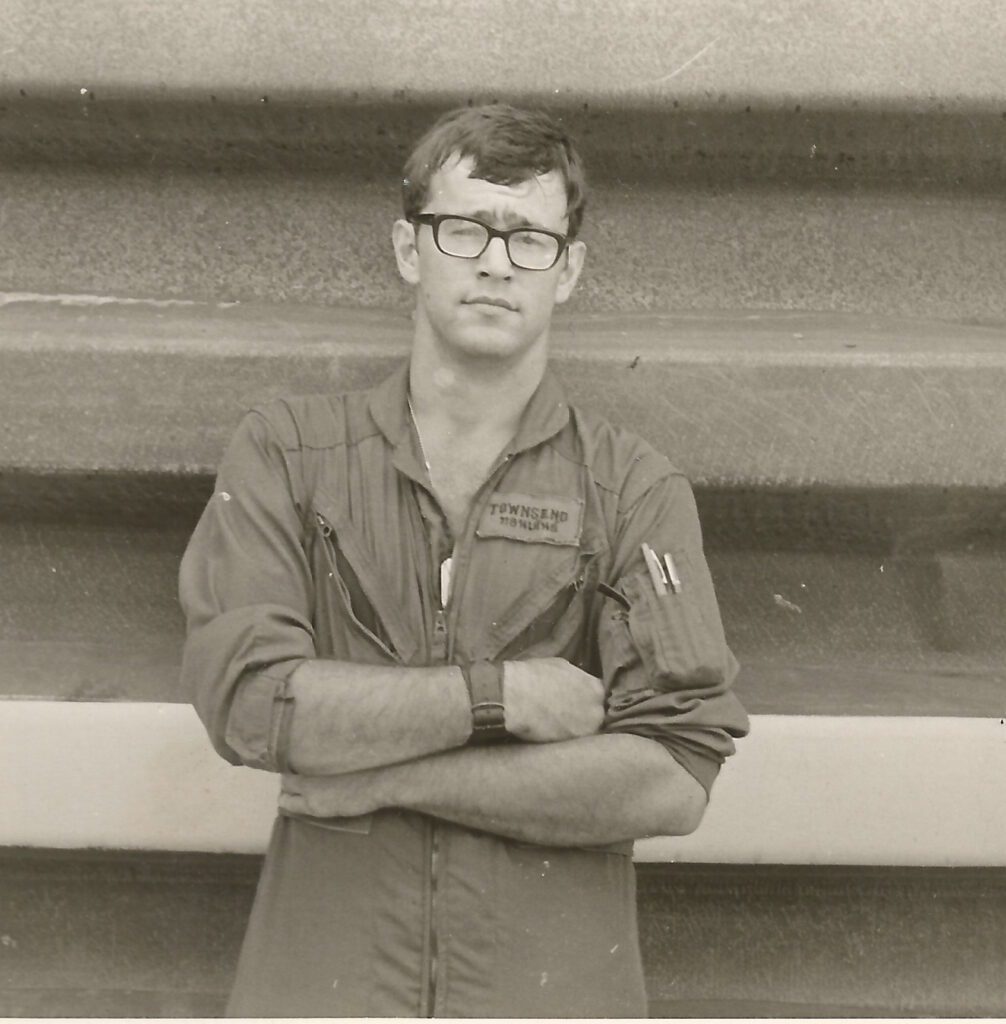
I volunteered to serve in Vietnam. I flew in the lumbering EC-121, monitoring with audio and seismic sensors the NVA supply routes along the Ho Chi Minh. Sometimes we were successful; We detected troops and trucks, called in FACs and gunships, and listened through our sensors or watched from the window ports, coffee cups in hand, as F-4Cs dropped CBUs on NVA 37mm AAA guns, the attacking pilots following luminescent AAA rounds to their source, strobe-lights marking the explosion of bombs. The AAA suppressed, the gunships sent long red lines snaking to the earth, trucks exploding one after another. Over Cambodia, I translated French to English for Cambodian officers.
I left Vietnam in December 1971. We had won. The Tet offensive decimated the Vietcong. The North Vietnamese had no remaining 18-year-out cohorts. We had killed them all and I was bored. An intelligence assignment to Berlin, Germany, had opened.
Fifty years later, I examine that young officer who arrived in Berlin, Germany, around Christmas 1971. The adjectives that come to mind are ‘feckless,’ womanizer, goalless, perhaps, “Good-Time Charlie.” Count Leo Tolstoi had populated War and Peace with such officers, and he didn’t like them much.
Berlin 1970s. Think Christopher Isherwood and Sally Bowles. Herbert Von Karajan directed the Berlin Philharmonic; Jessye Norman sang ‘Aida’ at the Berlin Opera; Eva Evdokimova danced “Giselle’ and “Swan Lake’ at the Berlin Ballet. My apartment looked out on the Grunewald. The Dahlem Museum had one of the best 17th-century Dutch Master collections in Europe. There were girls, lots of girls. It was as good as it got.

My work site was in the southeast Berlin Marienfelde District, a height where the WWII debris of bombed-out Berlin created a tall hill upon which we Americans constructed a 200ft high antenna tower and array. There was a maintenance elevator to the top, to which my sponsor, Captain Valentine, took me on New Year’s Eve 1971. We looked east into the darkness; not a creature was stirring. To the North and West, Berlin was a cacophony of noise, fireworks, light and color. Searchlights and floodlights marked the Berlin Wall; to the east, darkness and silence, as a Northern Wisconsin December night.
It was, however, not as it seemed.
The Soviet General Staff was upgrading the Group of Soviet Forces Germany with new fighters, tanks, artillery, and redundant and sophisticated command and control and communications as the US military sunk assets into Vietnam’s mud and corruption. Were the Soviet weapons defensive or offensive? For the soldier, it depended upon which end of the reticulated aperture into which you squinted.
North Vietnamese Army’s 1972 Eastertide Offensive. Talking with the guys via secure telephone, they were flying 16-hour missions every other day, and I regretted I wasn’t there. Again, the NVA combat losses were massive––50 – 70, 000 dead and wounded––but it was the way Communists did these things. Mass death meant little when a socialist heaven beckoned.
On 6 October 1973, a dense fog enveloped Berlin. Visibility was 20 meters. TSeveral Soviet transport aircraft had traversed the Cheb (the air corridor between Germany and Czechoslovakia) Chute to Cairo. The evacuation of dependents usually meant war, but Anwar Sadat had had previous snits with the Soviets, thrown them out, then little by little, they returned. Soviet racism, bless their souls, would do any Alabama Ku Klux Klan grand dragon proud.
It looked problematic in the Middle East, but the Israelis wouldn’t be surprised, would they? The Golan Heights, the Israeli defensive barrier against the rapacious Syrians, resembled the Baraboo Hills, near Madison, Wisconsin. The Israeli Army had better be on its toes.
I breakfasted at the Forsthaus Paulsborn (http://www.paulsborn.de/)––white and crisp table linens, silver table service and crystal glass––a German Emperor’s hunting shack (!) with stag-horn chandeliers. My table looked out over the Grunewald See, the beech and maple leaves falling into its still waters, its surface disturbed only by the passage of a white swan.
As I was sipping my coffee that early morning, 6 October 1973. The Israeli Defense Force, which knew its enemies intimately, had been deceived; the surprise was complete. The existence of Israel was in doubt. Israeli Defense Minister Dayan was in despair; The hard-nosed General Elazar Peled was more sanguine. The Israeli Army eventually prevailed, but as Wellington assessed at Waterloo, ‘It was a damn near thing!’
In 1975, North Vietnam conquered South Vietnam. The Khmer Rouge murdered half its population. The United States no longer needed, if it had ever, feckless officers. Amidst cataclysms both real and potential, I came to understand a few simple truths. When Communists assumed power, genocide ensued. In an age of moral relativity, one could and must distinguish between largely evil and largely good (Victor Hanson). We–the Vietnam generation of officers––threw ourselves into rebuilding our military. There was never enough time; there was never enough energy; there was never enough money.
By July 1989, I was exhausted. The free world would be fighting Communism forever, but without me. I had no more to give. I left the military and returned home to Wisconsin. In October 1989, the Berlin Wall fell. In December 1991, the Union of Soviet Socialist Republics (USSR) became the Commonwealth of Independent States (CIS) Former Soviet Union (FSU)
Who would have thought?
I had survived the barrel ride over the Niagara Falls. This cherished friendship lasted, my memories warm; that friendship died, and I feel still aching sadness and shame. On long Wisconsin winter nights, I revisit these battlefields of the mind. I write to right my own mistakes and deceptions. I rework situations, test my heroes, wish them to make wiser decisions, but alas, they are young and hopeful and live among the deceitful.
On the fly, I have learned from liars and storytellers, their truths and deceptions, for all of my conscious life. I wish now to make some sense of it. Liars and Storytellers will be a reassessment.
My southern relatives with their penchant for aphorism and pithy statement note that a ‘.301-lifetime batting average might get you into the Hall of Fame.’ How does one discern the liars from the storytellers? Can’t one do better than .301? Probably not.