

September 7, 2010
A clap of thunder ricochets down Park Street in the space between the Mosse Humanities Building and Chadbourne Hall. Winds off Lake Mendota drive sheets of cold rain upon students in flip-flops and T-shirts, who screech and laugh, excited this first day of school, energized by lightning and ionized air, unconfined by home or hometown.
I stand under an overhang as the class of 2014 or so stream home in flowing ankle-high rainwaters. The scene is black and white, like a Jean-Luc Godard movie popular when I was their age, where the actor sees children running across his vision, and we know he is seeing his younger self. So it is this day. I am auditing History 419, History of the Soviet Union.
I had been here before. In 1967, in a lecture in Bascom Hall, Professor Michael Petrovich taught a different Soviet History. Five years earlier, the Cuban Missile Crisis; two years earlier, the Battle of the Ia Drang Valley; in Washington, D.C., a Navy code clerk named John Walker offered the KGB Station Chief, Solomatin, US Navy codes; 700,000 US Troops were learning jungle combat in Vietnam.
In 1967, Soviet Foreign Policy 317 could as well have been Martian Astrology 317, so senseless it seemed to me. Much concerned me that year: transportation to my job, 20 blocks off campus; eight credits of Russian; my girlfriend had missed her period. My classmates seemed scions of America’s aristocracy, financially secure, une vie sans souci. Such unhappiness they suffered was like that neighborhood dog that would dig a hole, then bark in it for hours. So it seemed the anti-Vietnam War movement gave meaning to empty lives.
I now realize that Professor Petrovich, who had seen much, tread carefully when describing the Soviet Union, and never used the word ‘genocide’ in a Soviet context. Soviet Genocide? Come on! Where is your evidence? Robert Conquest? He’s anti-Communist. Though the Soviet Union was out of style in 1967, Red China was a ‘miracle of human equality’ as the ‘Cultural Revolution’ was unleashed to cleanse ‘bureaucratism,’ with renewed revolutionary fervor.
I stood at the edge of some spring demonstration listening to a smarmy activist graduate student: “I am among the growing number of Americans who believe this government must be overthrown.” That worn-and-tired phrase of tired-and-worn Communist activists was new and shocking to me. I looked at him and visualized the German Hitlerjugend Kristallnacht leader smashing the first Berlin window. Later during that 1967 spring, American Jugend would smash windows on State Street.
In 1967, the evidence was unclear. To me, the Soviets confiscated the farmers’ land and put them on collective farms. I loved beyond words the land upon which I grew up. I was anti-communist because the Communists confiscated farmland.
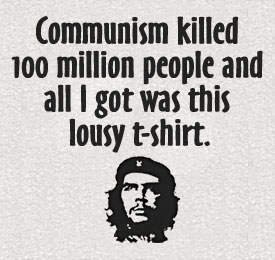
On the University of Wisconsin campus, the contending political issues were Maoism, Stalinism, and Trotskyism. Other students, born in another solar system – Queens, New York, or Winnetka, Illinois – made pilgrimages to Cuba and wore T-shirts with the image of the recently executed Che Chevarra.
I volunteered for Vietnam.
In the Fall 2010 The Black Book of Communism was published and the dead spoke.